
GrizCam Desktop Software and Bioacoustics
Supported AI models in GrizCam Desktop
Run ready-made AI detectors (BirdNET+ from the BirdNET team, Perch 2.0, PNW-Cnet and Cry Wolf), then build your own: train, test and run detectors from your own recordings on Perch and Earth Species Project foundation models, with no code.


Works with
Standard audio files from most ARUs (WAV, FLAC and MP3, ultrasonic included), tens of thousands at once, even on a laptop.
Our acoustics-only recorder: 280 days without solar. Every recording carries GPS time, so several units line up to locate where a sound came from.
Meet the recorderA six-microphone array gives the direction of every sound from a single unit, and the onboard compass turns it into a true bearing on the map.
The collar’s motion sensors rebuild the animal’s path beside its audio, so you can follow it across the landscape and hear what it said.
Follow one animalRecord it in the field. Find it on your laptop.
1 · Record
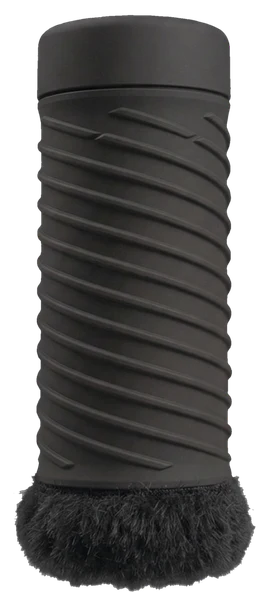
GrizEars is our acoustics-only field recorder, built into the GrizCam battery housing. It stands 7 inches tall and records locally for 280 days without solar.
Taking pre-orders2 · Run the AI
AI annotate in GrizCam Desktop runs four ready-made detectors over a folder of recordings, free: BirdNET+ from the BirdNET team (more than 11,500 species and sound classes, birds and other wildlife worldwide), Perch 2.0 from Google (birds and many other species), PNW-Cnet from the USDA Forest Service (owls and other Pacific Northwest species) and Cry Wolf (wolf howls and wolf choruses). Narrow BirdNET+ to the species that occur where you recorded, or report everything it hears.
3 · Train your own
When the sound you are after is not on any list, train a detector from your own annotated recordings, with no code, on bioacoustic foundation models from Perch and Earth Species Project. GrizCam Desktop tests it on whole recording sites and months it never heard and shows its precision, recall and false alarms per hour, so you know how far to trust it. Then it runs in AI annotate beside the others.
4 · Review and keep
Every detection lands in the annotation table on its spectrogram, where you listen, check and keep what is right. Nothing becomes an annotation until you say so.
Two recorders, one workspace.
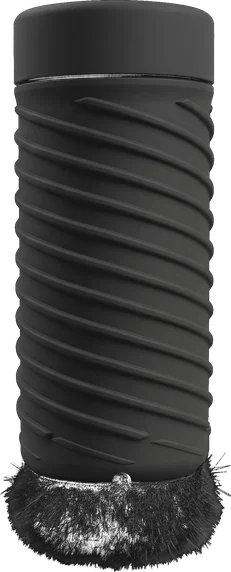
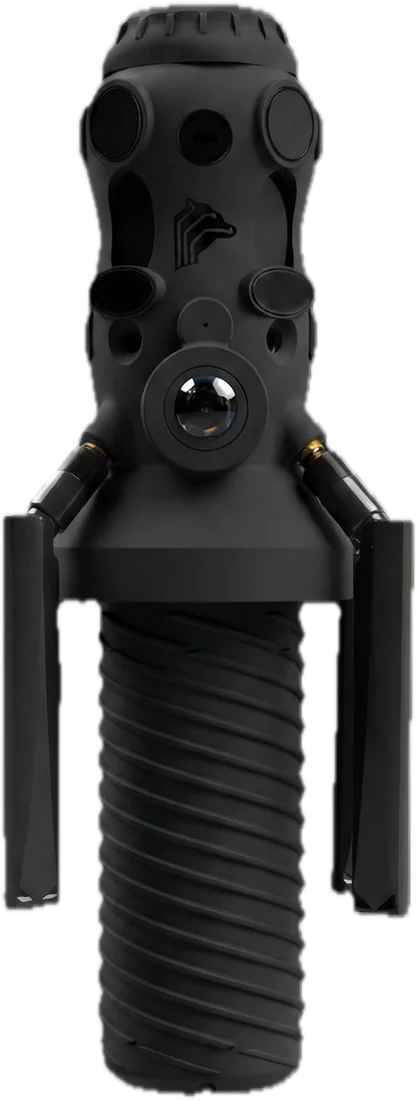
| GrizEars | GrizCam | |
|---|---|---|
| Records for GrizCam Desktop | Yes | Yes |
| GPS timestamp in every recording | Yes | Yes |
| Several units → acoustic localization | Yes, with GrizCam Desktop or other software | Yes, with GrizCam Desktop or other software |
| Direction of arrival from one unit | No | Yes, with true bearing |
| Sees and smells | No | Yes: 280° field of view up to 4K, compound sensing |
| Sends data out | No: records locally | Mesh, cellular, encrypted offline storage (satellite coming soon) |
| On battery | 280 days without solar | Months on battery; continuous on solar |
| Taking pre-orders |
Spread GrizEars across many sites, and their GPS-timed recordings can show where a sound came from. Add GrizCam where one unit should tell you which way, and where you need to see it.
What is free in GrizCam Desktop.
- AI annotate: run BirdNET+ (from the BirdNET team; birds and other wildlife worldwide), Perch 2.0 (birds and many other species), PNW-Cnet (owls and other Pacific Northwest species) and Cry Wolf (wolf howls and wolf choruses) over thousands of recordings from any recorder, and review what they find before adding it to your annotations.
- Build your own AI, no code: train a detector from your own recordings on Perch and Earth Species Project foundation models, tested on whole sites and months it never heard, with its precision, recall and false alarms per hour shown before you trust it.
- WAV, MP3 and FLAC files from any recorder, on Windows or an Apple‑silicon Mac.
And what it does with them
- Recorder maps, call clustering and acoustic indices.
- Biologger and collar tracks over the audio.
- Direction of arrival from GrizCam's six‑microphone array.
- With a GrizCam and Pro, camera captures played with the audio around them.
See what the
device hears.
The same engine GrizCam Desktop uses to turn a recording into video. Press play.
Follow one animal.
The video below is a reconstruction, not camera footage: 17 days in the life of wolf 1513F of Yellowstone’s Rescue Creek pack, rebuilt from the data her collar and those of the wolves around her recorded. In the winter of 2024–25 she traveled more than 300 kilometers across the park’s Northern Range, and her collar logged the journey: GPS for where she was, and a biologger on the collar for the rest: a motion sensor for how she moved, a compass for which way she faced and a small microphone for the sounds she made. It let us hear what GPS alone never could, and it suggests that individual wolves may vocalize far more than we thought. Her collar recorded about 26 minutes of howling and calling a day, roughly a fifth of the two hours a day the average American spends talking.
The golden line is her path, and the blue arrow is her, pointing where she faced. Each colored name is another collared wolf. Her pack numbered roughly 16 at the time, but only four of the others wore collars; those four are shown the whole time. Wolves from other packs appear when they were within 10 kilometers of her as she called. Each ring spreading across the ground is one of her howls or choruses, traveling out over the terrain toward whoever might be listening. Each ring’s color reflects the pitch of the call: the center of the call’s annotated frequency range is placed on a logarithmic (octave) scale from 150 Hz to 2.4 kHz and mapped from deep pink for low howls to yellow for the highest calls. Near the wolf, each ring starts in the color of the call’s highest frequency and shifts toward its center color as it spreads, a cue for the fact that air absorbs high frequencies first. The glowing dot it leaves behind marks a place she called from, and those dots stay on the map so we can learn if wolves are using howls to mark their territory. You’ll hear over 100 vocalizations of the 941 sounds we found on her recordings. Every one comes from a wild wolf, free across hundreds of kilometers of winter, reaching out across the valleys to her pack and to the neighboring wolves within earshot.
How this video is made
The video is drawn from three records. The first is her GPS collar's positions. The second is her biologger's motion, compass and audio recordings. The third is the GPS positions of the other collared wolves in the park's long-term monitoring data. Nothing on screen is drawn by hand. Each element below comes from a stated rule, and where a rule has a setting, the value used for this video is given.
Read the full methods and statistics
Her path: GPS-anchored dead reckoning
Her collar recorded a GPS fix every 10 minutes (hourly for 11 stretches) from December 19, 2024, 18:00 to January 5, 2025, 23:50: 2,429 fixes. Joined by straight lines, those fixes measure 301 km. That is a lower bound, because she did not walk in straight lines. Between fixes, the biologger recorded acceleration at about 49 samples per second and the magnetic field at about 10 samples per second. We use these to reconstruct the route between fixes (dead reckoning), anchored to GPS (Bidder et al. 2015; Dewhirst et al. 2016; Gunner et al. 2021):
- Heading. The biologger is fixed rigidly to the right side of the collar. The collar is fitted snugly and does not rotate on the neck. The collar's battery and GPS unit sit about 5 cm (2 inches) from the magnetometer, and small metal bolts hold the logger. The magnetometer was never calibrated, and it stores raw readings. Those readings carry a constant offset that moves with the collar (in navigation terms, a "hard-iron" offset). This is the usual effect of nearby magnetized parts, though we have not isolated which part causes it. We estimate the offset from her own data (Vasconcelos et al. 2011; Bidder et al. 2015) by fitting a sphere to the magnetometer readings pooled from all 359 hours of her recordings: Earth's field has one strength, so the right offset makes every corrected reading the same length. With the offset removed, the measured field strength varies by 5% instead of 27%. The corrected reading is then leveled using the direction of gravity from the accelerometer (a 2 Hz low-pass of the acceleration). The heading is the compass direction of the sensor's X axis projected onto the horizontal. In her data that axis lies close to level (half of all readings within −19° to +13° of horizontal). Lowering her head did not measurably affect the heading. Stretches where she held her head higher, or moved it a lot, agreed with GPS a few degrees less well (a median of 13° from the GPS direction of travel instead of 10°). A sharply raised head, as when howling, has not been tested.
- Activity. Overall dynamic body acceleration (ODBA; Wilson et al. 2006; Qasem et al. 2012) is the summed absolute acceleration left after gravity is removed. We average it over 1 second and subtract the recording's resting level (its 10th percentile). Over 10-minute segments, ODBA correlates with GPS distance at r = 0.84 for this collar (measured over her first 120 hours).
- Walk. At each compass sample, the path takes a step of length activity × time in the heading direction.
- Calibration. We fit two numbers for the whole deployment. One is a speed factor that converts activity to meters. The other is a single compass rotation between the sensor's heading and her direction of travel over the ground. When the heading is measured from magnetic north, the fitted rotation is 13°. The magnetic declination there (the gap between magnetic and true north) was 10.9° east ± 0.4° (World Magnetic Model 2025, at her range on December 27, 2024). So the rotation is almost exactly declination: the X axis points along her direction of travel to within about 2°. A second biologger collar of the same model and mounting, on wolf 1507F, gave the same rotation independently. Fitted day by day, 1513F's rotation stayed steady (standard deviation 8°; see "Stability over time"). Both are fitted to the GPS displacement of every stretch between fixes in which she moved at least 25 m: the speed factor by least squares, the rotation as the displacement-weighted mean angle between the walked and the GPS direction.
- Anchoring. On its own, the sensor path drifts: over a 10-minute stretch of travel it ended a median of 101 m from the next GPS fix (9 in 10 within 242 m), which is 42% of the distance she had actually moved. So the remaining end error of each segment is spread evenly over that segment, and every piece starts and ends exactly on its two real GPS fixes. The path can be wrong between fixes, but never at a fix.
- Still pieces. Where the reconstructed speed over a segment averages under 0.25 m/s, we draw the straight line between the fixes instead. When a wolf stays put, her motion comes from feeding, play or shaking, not travel. The threshold was not chosen by eye: the accuracy test below picked it from seven candidates as the value with the lowest error for this collar.
Of her 2,428 ten-minute stretches, 936 (39%) are drawn from the sensors. 1,162 are drawn as straight lines because she was nearly still. 330 are straight lines because the biologger was not recording: 72 before it started, 251 after it stopped, and 7 brief gaps.
How accurate the path is
We tested the method on her own data. We hid every other GPS fix, reconstructed the path across the resulting 20-minute gaps, and measured how far the reconstruction was from each hidden fix (2,096 hidden fixes). We did the same for a straight line drawn between the remaining fixes.
| Distance from the hidden GPS fix | Our path | Straight line |
|---|---|---|
| Average error | 32 m | 62 m |
| Half of points within | 10 m | 7 m |
| 3 in 4 points within | 49 m | 85 m |
| 9 in 10 points within | 90 m | 202 m |
| 99 in 100 points within | 237 m | 425 m |
| Within 100 m | 92% | 77% |
Where she was traveling (the 960 test gaps where the path was reconstructed from the sensors), the method's advantage is largest:
| While she was traveling | Our path | Straight line |
|---|---|---|
| Average error | 64 m | 130 m |
| Median error | 51 m | 98 m |
| Within 100 m | 83% | 51% |
The reconstruction was closer than the straight line in 68% of these cases. It was more than 50 m better in 50% of them and more than 50 m worse in 14%. It helps most when she moved fast, and not at all at a slow amble:
| Her average speed across the gap (from the sensors) | Cases | Closer than a straight line |
|---|---|---|
| Faster than 1 m/s | 386 | 89% |
| 0.5 to 1 m/s | 392 | 59% |
| 0.25 to 0.5 m/s | 182 | 42% (no better than a straight line) |
At the median, a straight line is slightly closer (7 m against 10 m). When she did go straight, the reconstruction adds a few tens of meters of wander. Its value is in the large detours a straight line misses entirely.
Without the hard-iron correction, the reconstruction is worse than a straight line: an average error of 150 m against the straight line's 130 m while traveling.
How we checked the method
- Calibration kept separate from testing. We repeated the accuracy test with the speed factor and compass rotation fitted on every day except the one being tested. The results did not change: 32 m average error, against 62 m for a straight line. The calibration is not flattering its own test.
- The compass against GPS. On her 383 fastest ten-minute stretches (300 m or more between fixes), we compared her average compass heading with the GPS direction of travel. The median difference was 9°, 92% were within 20°, and on average there was no bias (+1°).
- A mirror test. If the compass axes were set up the wrong way round, left turns would read as right turns. With the heading deliberately mirrored, the reconstruction becomes far worse than a straight line (85 m average error against 62 m). The heading as used is the right way round.
- Clocks. The biologger's sensors and microphone share one clock, but it is not synchronized with the GPS clock. We checked the gap between them by sliding the motion record against the GPS movement in 30-second steps. The match peaks within half a minute of zero. Day by day, it stays within −1.5 to +1 minute, with no drift across the deployment.
- Stability over time. Fitted day by day, the compass rotation varied with a standard deviation of 8°, and the hard-iron offset stayed within about 50 units on each axis (the sensor's raw units, in which Earth's field measures about 374). There was no drift that would suggest the collar turning on her neck from one day to the next. The largest departure was the first, partial day, which had only 9 moving stretches and fitted 28° from the average. Two days (December 20 and January 2) gave a lower speed factor than the rest.
- The still threshold barely matters. Across all seven candidate thresholds, the average error ranges only from 32 m to 35 m.
- A second wolf. The same method on wolf 1507F's biologger collar gave 31 m average error against 73 m for a straight line. While she was traveling, it was closer than the line in 78% of cases.
How time is shown
The video compresses 17 days into minutes, and not at a constant rate. Travel is paced so the ground streams past at a steady speed, and it speeds up (up to four times) through long stretches between calls. Each call plays in real time.
An inactive period is any stretch of at least 20 minutes in which her activity-based walking speed, averaged over 60 seconds, stays below 0.1 m/s: far below a wolf's usual travel speed of about 2.4 m/s (Mech 1994) and less than half the average speed of wolves over all their active time, about 0.26 m/s (Theuerkauf et al. 2003). A brief stirring of up to 5 minutes in which she moved no more than 50 m (shifting, turning around, shaking) does not end one, so one bedding-down counts once. The rule is ours: no published standard defines a wolf's rest from a collar accelerometer. Its 20 minutes follows the Voyageurs Wolf Project's GPS-cluster rule, two or more consecutive 20-minute fixes within 200 m, which they use to find where wolves stopped (Gable et al. 2023). Joining still spells across short breaks follows sleep scoring from collar accelerometers in wild baboons, which joined blocks up to 45 minutes apart (Loftus et al. 2022); we join at most 5 minutes. We call these periods inactive rather than resting because chewing can look like standing still or lying to a collar accelerometer (Lorand et al. 2025, captive wolves). Each one is shown as a violet dot with its real length ("Inactive 2 h 10 min") and lasts at most 1.5 seconds of video, however long it really was.
When she was inactive
She was inactive for 190 of her 359 recorded hours (53%), in 115 periods. A typical period lasted 76 minutes (mean 99 minutes; the longest 5 hours). On her 13 fully recorded days she was inactive for 12.4 hours a day on average (median 12.0), from 8.7 hours on January 1 to 16.2 hours on December 31. That is close to the roughly 55% inactivity, in bouts averaging about an hour, recorded for radio-tracked wolves in Poland (Theuerkauf et al. 2003). The second biologger wolf, 1507F, was inactive 57% of her recorded time, 13.9 hours a day on average (9.9 to 19.2).
She was most active around sunrise and sunset. Each percentage below is the share of that part of the day's own recorded hours that she spent inactive, so the column does not add up to 100%:
| Part of the day | Hours recorded | Share of those hours spent inactive |
|---|---|---|
| The hour either side of sunrise and of sunset | 60 | 28% |
| The rest of the day | 102 | 51% |
| Night | 197 | 62% |
| All | 359 | 53% |
Her least inactive hours were 08:00 to 10:00 and 16:00 to 18:00 (sunrise about 07:56, sunset about 16:43), and her most inactive 03:00 to 05:00 and 12:00 to 14:00. This is the crepuscular pattern reported for Yellowstone's wolves from GPS (Kohl et al. 2018). One Yellowstone study defined dawn and dusk by astronomical twilight, with an hour either side (Anton 2020, a doctoral dissertation). By that definition she was inactive for 51% of the 60 hours of twilight, 42% of the 155 hours of day and 65% of the 144 hours of night. In midwinter at this latitude those twilight windows (about 05:10 to 07:10 and 17:30 to 19:30) fall mostly in darkness, before sunrise and after sunset, so they miss her real peaks of activity; we report both. (All times are Mountain Standard Time.)
Howling keeps a different clock. Here we count bouts of howling: each howl sequence or chorus counts once, however many howls it holds. She had 190 bouts (366 minutes of howling). We asked how often she howled in each part of the day. The parts are different lengths, so for each one we divide the bouts by the hours recorded in it. That gives a rate, bouts per hour, which says how often she howled there; it is not a share of her howling, so the rates do not add up to 100%. The share is in the last column.
| Part of the day | Hours recorded | Bouts | Bouts per hour | About one bout every | Share of her bouts |
|---|---|---|---|---|---|
| Night | 197 | 136 | 0.69 | 1½ hours | 72% |
| The hour either side of sunrise and of sunset | 60 | 33 | 0.55 | 2 hours | 17% |
| The rest of the day | 102 | 21 | 0.21 | 5 hours | 11% |
| All | 359 | 190 | 0.53 | 2 hours | 100% |
So she howled most often at night, about once every hour and a half, against once every five hours in the middle of the day. By the clock, the 22:00 hour was her busiest: we recorded that hour on 15 nights, and she began 24 bouts in it. The three hours after sunset, 17:00 to 20:00, had about one bout each per evening (16, 17 and 14 bouts over 15 evenings), and from 11:00 to 16:00 she began only 5 bouts in 15 days. By the astronomical-twilight definition, twilight becomes her most frequent time: 47 bouts in 60 hours of twilight (about one every 1.3 hours), 96 in 144 hours of night (one every 1.5 hours) and 47 in 155 hours of day (one every 3.3 hours).
Of her 190 bouts, 78 (41%) began while she was inactive, though she was inactive for 53% of her recorded time. Nearly all of those were at night: 73 of her 136 night-time bouts began from an inactive period, against 5 of the 54 by day and around sunrise and sunset. So she moved most around dawn and dusk, but howled most at night, often from where she lay. The second wolf, 1507F, howled about as often by day as by night (0.39 and 0.37 bouts per hour, about one every 2½ to 3 hours) and least around sunrise and sunset (0.16, about one every 6 hours).
How her collar tilts: the gauge beside the date
While a call plays, a small gauge beside the date shows how her collar is tilted compared with how she carries it while traveling: level is her traveling posture, up is nose up. The tilt is the angle of the collar's forward axis to the horizontal, from the direction of gravity in the accelerometer (the same 2 Hz low-pass); the traveling posture is the median over her most active quarter of the time. The collar sits on her neck, so this is the neck's tilt, not the head's. Lying down bends the neck as much as a raised head, so the gauge shows its needle only while she is upright: while the collar's roll is within 30° of its roll when she travels.
| 1513F | 1507F | |
|---|---|---|
| Day-to-day change in the collar's roll while traveling (standard deviation) | 1.2° (16 days) | 1.0° (22 days) |
| Howls and choruses measured | 738 | 1,350 |
| Tilt during the call, compared with traveling (median; middle half) | 28° up (18° to 37°) | 43° up (33° to 52°) |
| Change from the minute before the call (median) | 6° up | 14° up |
| Calls that tilted up from the minute before | 70% | 89% |
| Wilcoxon signed-rank test, call vs. minute before | p < 10⁻⁴⁰ | p < 10⁻¹⁷⁰ |
| Calls made upright (roll within 30° of traveling) | 92% | 98% |
The table above measures each call over its whole annotation, pauses included, and counts howls and choruses together, so a chorus includes her packmates' voices. The figures below look only at her own howls, only at the moments she was voicing, and take each howl's peak; that is why they read a few degrees higher.
Looking at every one of her howls (540 annotated as "howl" and 2 as "growl howl"), we measured the tilt only while she was actually voicing and upright: the recording, filtered to each howl's own annotated frequency band, within 10 dB of that howl's loudest moment, every 0.1 s (about half of each annotation; the rest is silence between notes). For each howl we took its peak tilt as the 90th percentile over those moments, so a single jolt of the head cannot set it. She was upright with data for 95% of her howls. Relative to her traveling posture, their peak tilt averaged 32° up (median 33°; the middle half of howls between 25° and 42° up; extremes 25° down and 73° up). Neither growl-howl had upright moments to measure.
Thirty-two howls (6%) still read below level at their peak. They came in a few bouts rather than at random (for example nine between 19:00 and 19:05 on December 20, and seven between 22:07 and 22:09 on December 30), and 26 of the 32 began while she was inactive, with the collar upright (not lying on her side). So they were most likely made, or heard, while she lay on her chest with her neck low: either she howled without lifting her neck far, or a packmate bedded beside her was howling. The collar alone cannot tell which.
The collar did not turn on her neck. Howls and choruses tilted it up, both compared with traveling and compared with the minute before the call, on both wolves. Snoring, which happens lying down, read as steep as a howl or steeper (median 39° up, five bouts), but in three of the five the roll was far from upright; that is why the gauge uses roll to decide when to show its needle. In captive wolves, head angle was among the most important accelerometer features for telling behaviors apart, and howling was often confused with standing still or lying (Lorand et al. 2025); our data show the same overlap. These figures have not been checked against camera footage, the choruses include her packmates' voices, and there are only five snoring labels.
Her calls
Which sounds play. We annotated 941 sounds by hand on her recordings: their type, start, end, and the band of frequencies they occupy. The video plays a selection of 122 of them, chosen by us. Each plays its own recording, at most 10 seconds of it, at the moment and place it was made. Several calls at the same GPS position play back to back. A call is placed at the GPS fix nearest in time to it. With fixes every 10 minutes, that fix is at most 5 minutes away (up to 30 minutes in the 11 stretches when the collar fixed hourly), and she may have been that much travel away from where she actually called.
The rings. Howls and choruses, the long-range calls wolves use across their territories, draw expanding rings; which sound types draw rings is a setting (the types ticked in the map's info box). In this video, softer, close-range sounds (whines, moans, growls) play their audio without rings. The rings are true circles on the ground, draped over the terrain, and reach 6 km from her. That is a display setting. It sits within the published range: Harrington and Mech (1979) found that wolves in Minnesota forest answered howls from at least 9 km away; people, they noted from earlier observers, can hear wolf howls about 6.5 km away in forest and up to 16 km across open tundra. In more recent field tests, people heard imitated howls up to 1.76 km away (O'Gara et al. 2020), and recorders detected wolf howls up to 3 km away (Suter et al. 2017). Each ring:
- dims as it spreads, by the same step for every doubling of distance, from full strength within 50 m of her to 35% at its edge. This echoes how sound weakens as it spreads, but the step is a display choice, not a calculated loudness;
- takes its color from the call's pitch: the center of its annotated frequency band (the geometric mean of the band's lowest and highest frequency), on a logarithmic scale from 150 Hz to 2,400 Hz. Low howls are deep pink, then orange, and high whimpers yellow;
- starts near her in the color of the band's highest frequency and shifts to the call's center color by about 60% of the way out. This is a visual cue for the fact that air absorbs high frequencies first (ISO 9613-1; Bass et al. 1995); no absorption is calculated;
- expands far faster than sound travels. The speed is chosen so the rings can be followed on screen.
The rings show a plausible reach, not a model of how the sound actually traveled. Terrain, snow, wind and temperature are not modeled.
The sound dots. When a call ends, a dot in its pitch color stays at the place she called from, for the rest of the video. The dots exist because one of the questions this research asks is whether wolves use howling to mark their territory. Harrington and Mech (1979) tested how wolves in Minnesota answered human-imitated howls and concluded that howling helps packs hold territory at a distance: it tells neighboring packs where a pack is right now, so they can keep apart without meeting. Packs answered most readily where they had something to defend (a kill with food left on it, or pups) and replied less as a kill was eaten. If her howling marks territory, her calls should not be scattered evenly along her route. They should cluster where her pack's range meets its neighbors' and at places worth defending. As the dots build up, they map where she called across the landscape, so anyone can see whether that pattern appears. A dot's brightness halves for every 12 hours of her time since it was made, down to a floor of 12%, so recent calls stand out but none disappear; the 12 hours are counted back from her latest call. Several calls at one GPS position leave a single dot, in the color of the last of them.
The other collared wolves
The other wolves come from the Yellowstone Wolf Project's GPS collar records (Yellowstone National Park, National Park Service). A wolf is included if it was collared during her deployment and came within the area she covered (with a margin of half its width on every side). Pack membership is the pack recorded for each collar at the start of the deployment.
- Her pack (Rescue Creek) is shown throughout. 1514F's collar fixed every 10 minutes, like hers. 1393M, 1511M and 1512F fixed every 6 hours (sometimes hourly).
- Wolves from other packs appear only while she calls. A wolf is shown if its collar had a fix (or a sighting) within an hour either side of the GPS fix her call is placed at and within 10 km of her, and its position on screen at that moment is also within 10 km (the hour is a fixed rule; the 10 km is a setting of the video).
- Ground sightings (someone saw the wolf) are not GPS fixes. A sighting places a wolf only within an hour of when it was seen, and is never joined to its GPS track.
Between its own GPS fixes, each wolf is placed on the straight line between them, at the video's current moment. That straight line is used for gaps of up to 24 hours: on the three 10-minute collars, thinned to longer gaps, it was closer on average to where the wolf really was than leaving the wolf at its nearest fix, at every gap length we tested, from 20 minutes to 24 hours (by 25 to 50%). Across a longer gap, the wolf waits at its fix nearest in time. Other wolves are not dead-reckoned. While she calls, the clock holds at her GPS fix, so the other wolves stand still. Each one's label shows its distance from her, for wolves at least 50 m away.
How exact those positions are. Only she, her packmate 1514F and 1507F of the 8 Mile pack wore collars that fixed every 10 minutes; for them, the positions and distances on screen are close to exact. Most other collars fixed every 6 hours (one hourly, one every 12 hours). To see how far off the straight-line placement is, we thinned 1514F's 10-minute track to one fix every 6 hours and placed her by the same rule at the moments of the video's calls. The placed position was a median of 0.5 km from where she really was, and 9 times in 10 within 2.5 km. Within half an hour of a real fix it was a median of 40 m off; two to three hours from one, about 1 km. So for those wolves the video shows which wolves were in the area, and roughly where, not exactly where each stood when she called. When a wolf's nearest real fix is 25 minutes or more from that moment, its label says how far in time that fix is, before or after (for example "2.1 km · fix ±2 h"). The 25 minutes is where, on the 10-minute collars, the straight line's typical error passes 30 m, about what a GPS collar fix itself can be off by: in a field test in mountainous terrain, half of the fixes fell within 5.9 m and 95% within 30.6 m of the true position (D'Eon et al. 2002), and another field test found a median error of 17 m (Ironside et al. 2017). A label without it is based on a real fix within 25 minutes, so its position is about as good as a GPS fix. Both thresholds are worked out by the app from the collars in the data, not fixed in advance. No distance is shown for a wolf closer than 50 m to her: that is just above two collars' combined 95% GPS error under good conditions (about 43 m), so closer than that they cannot be told apart from being together.
What she said over 17 days
Her collar recorded 359 hours of audio, essentially continuously from December 20 to January 4. Every sound below was annotated by hand.
| Kind of sound | Annotations | Total time (overlaps merged) |
|---|---|---|
| Howls (single howls and howl sequences) | 742 | 154 min |
| Choruses (the pack howling together) | 110 | 227 min |
| Close-range calls (moans, whines, whimpers, growls, barks and other soft calls) | 65 | 16 min |
| Non-vocal and other sounds (snoring, running, swimming, play, scratching, resting, other) | 24 | 24 min |
Total vocal time was 382 minutes, about 26 minutes a day, after overlapping annotations are merged so no second is counted twice. Howls and choruses make up 96% of it. Her collar's microphone also hears the wolves around her, so a chorus includes her packmates' voices.
When she called. Mostly in the evening and at night. Her busiest hours were 22:00 to 00:00, with about 3.4 minutes of calling in an average hour. From 12:00 to 15:00 she was almost silent. (All times are Mountain Standard Time, the collar's clock.)
Calling and travel. We grouped her recorded clock hours by how far she moved in them (the straight-line GPS distances between her fixes in that hour, added up) and counted her calls of every vocal type in each group. Here a call is one annotation, so each howl in a sequence counts on its own.
| Distance she moved in the hour | Recorded hours | Hours with at least one call | Calls per hour |
|---|---|---|---|
| Under 100 m (nearly still) | 169 | 29% | 1.5 |
| 100 m to 1 km | 91 | 34% | 2.4 |
| More than 1 km | 99 | 40% | 4.5 |
She called more on the move: in 40% of the hours in which she covered more than a kilometer, against 29% of the hours in which she stayed nearly still, and about three times as many calls per hour. Of her howling bouts, 41% began while she was inactive (see "When she was inactive").
Silence. She called in 120 of her 359 recorded hours. Most of her silences were short: the median was 3 whole hours without a call.
Assumptions, stated plainly
- Effort is not distance. Feeding, play and shaking register as movement. The still rule removes the worst of this, but not all. Low motion is not always rest: feeding in place can count as inactive.
- The collar measures where her head points, which swings as she walks. The single compass rotation relies on the collar not turning on her neck. It is fitted snugly, and its roll while she traveled changed by only about 1° (standard deviation) from day to day.
- The magnetometer was never calibrated. We correct a constant offset (hard-iron) estimated from her own data, but not distortions that depend on direction (soft-iron). After correction, the field strength still varies by 5%.
- The two clocks are not synchronized. Our check puts them within about a minute of each other, which matters little against 10-minute fixes.
- The accuracy test is conservative and partial. It checks the path 10 minutes from a GPS fix. In the video no point is more than 5 minutes from a fix (30 minutes in the hourly stretches), so the video's error should be smaller, but that has not been measured directly. The test also checks only the positions at fix times, not the shape of the path between them. We treat each GPS fix as her true position. Day-by-day stability does not rule out the collar shifting briefly within a day.
- Calls are placed at the nearest GPS fix, up to 5 minutes from when she called (30 minutes in the 11 hourly stretches).
- The inactive-period rule (20 minutes, 0.1 m/s, 5-minute stirrings) and the 6 km reach are our choices, grounded in the literature, not measurements of this wolf. The rings show a plausible reach, not a propagation model.
- Other wolves are placed by straight lines between their own fixes, which are often hours apart.
- The human comparison is about time only, and is not like for like. The page compares her 26 minutes of calling a day with the roughly two hours a day people spend talking. The collar measures the time of calling it heard, packmates included; the human figure is the share of sampled moments in which a person was heard talking (Mehl & Pennebaker 2003), which counts conversations, pauses included, and comes from 52 college students.
Recreating the tables and figures
The figures above come from GrizCam Desktop, Grizzly Systems' desktop software, working from the collar's own files. Most of them can be recreated in the app's Statistics report:
- Open the folder holding wolf 1513F's biologger recordings and annotations in GrizCam Desktop, then open the Biologger Map.
- Tick Dead reckon. This reconstructs the path between GPS fixes and saves the result beside the recordings; if the map says a saved result is out of date, choose Regenerate.
- Open Statistics. The report's sound-type filter (the types ticked in the map's info box) decides which calls are counted; the dates cover the whole deployment.
| Table or figure | Statistics report section | Sound types ticked |
|---|---|---|
| GPS fixes and stretches; the accuracy test's average error, median error and 9-in-10 distance, and the traveling gaps (average error, share closer than a straight line); the miss before anchoring; the compass fit; the hard-iron correction | Dead-reckoning accuracy | any |
| Inactive periods: count, share of time, length, hours per day, the day / night / twilight table, hour by hour | Inactive periods | any |
| Howling bouts by day, night and twilight; busiest hours; bouts that began while inactive | Calls through the day | howl sequence, chorus |
| Time spent calling (26 minutes a day); calling and travel | Calls through the day (Time calling; Calling and travel) | every vocal type |
| Total time per row of the sounds table | Calls through the day (Time calling) | that row's types |
| Collar tilt during her howls | Collar tilt during calls | howl, growl howl |
| Silences: hours with a call, the median silence | Silences | every vocal type |
| How the other collared wolves are placed between their fixes (the straight-line gap limit, the fix-time label) | Other animals: placement between fixes | -- |
"Every vocal type" is every annotated type except snoring, running, swimming, play sounds, scratching, resting and other.
These come from separate analyses of the same files and are not yet in the report: the other rows of the two accuracy tables and the table by speed; the checks under "How we checked the method" (the day-left-out test, the compass against GPS, the mirror test, the clock check, the day-by-day fits, the still-threshold sweep and 1507F's results); the correlation of activity with GPS distance; the tilt table comparing the two wolves and the day-to-day stability of the collar's roll; the test of how far a straight line places a wolf whose collar fixes every 6 hours (from wolf 1514F's 10-minute track, thinned); 1507F's inactivity and howling rates; and the human comparison (from the cited study).
Sources
- Anton, C. B. (2020). The demography and comparative ethology of top predators in a multi-carnivore system [Doctoral dissertation, University of California, Santa Cruz]. eScholarship. https://escholarship.org/uc/item/3xd9379b (not peer-reviewed)
- Bass, H. E., Sutherland, L. C., Zuckerwar, A. J., Blackstock, D. T., & Hester, D. M. (1995). Atmospheric absorption of sound: Further developments. The Journal of the Acoustical Society of America, 97(1), 680–683. https://doi.org/10.1121/1.412989
- Bidder, O. R., Walker, J. S., Jones, M. W., Holton, M. D., Urge, P., Scantlebury, D. M., Marks, N. J., Magowan, E. A., Maguire, I. E., & Wilson, R. P. (2015). Step by step: Reconstruction of terrestrial animal movement paths by dead-reckoning. Movement Ecology, 3, 23. https://doi.org/10.1186/s40462-015-0055-4
- D'Eon, R. G., Serrouya, R., Smith, G., & Kochanny, C. O. (2002). GPS radiotelemetry error and bias in mountainous terrain. Wildlife Society Bulletin, 30(2), 430–439.
- Dewhirst, O. P., Evans, H. K., Roskilly, K., Harvey, R. J., Hubel, T. Y., & Wilson, A. M. (2016). Improving the accuracy of estimates of animal path and travel distance using GPS drift-corrected dead reckoning. Ecology and Evolution, 6(17), 6210–6222. https://doi.org/10.1002/ece3.2359
- Gable, T. D., Johnson-Bice, S. M., Homkes, A. T., & Bump, J. K. (2023). Differential provisioning roles, prey size, and prey abundance shape the dynamic feeding behavior of gray wolves. Communications Biology, 6, 1045. https://doi.org/10.1038/s42003-023-05419-4
- Gunner, R. M., Holton, M. D., Scantlebury, M. D., van Schalkwyk, O. L., English, H. M., Williams, H. J., Hopkins, P., Quintana, F., Gómez-Laich, A., Börger, L., Redcliffe, J., Yoda, K., Yamamoto, T., Ferreira, S., Govender, D., Viljoen, P., Bruns, A., Bell, S. H., Marks, N. J., … Wilson, R. P. (2021). Dead-reckoning animal movements in R: A reappraisal using Gundog.Tracks. Animal Biotelemetry, 9, 23. https://doi.org/10.1186/s40317-021-00245-z
- Harrington, F. H., & Mech, L. D. (1979). Wolf howling and its role in territory maintenance. Behaviour, 68(3–4), 207–249. https://doi.org/10.1163/156853979X00322
- International Organization for Standardization. (1993). Acoustics — Attenuation of sound during propagation outdoors — Part 1: Calculation of the absorption of sound by the atmosphere (ISO Standard No. 9613-1:1993). (standard, not peer-reviewed)
- Ironside, K. E., Mattson, D. J., Arundel, T. R., & Hansen, J. R. (2017). Is GPS telemetry location error screening beneficial? Wildlife Biology, 2017(1), wlb.00229. https://doi.org/10.2981/wlb.00229
- Kohl, M. T., Stahler, D. R., Metz, M. C., Forester, J. D., Kauffman, M. J., Varley, N., White, P. J., Smith, D. W., & MacNulty, D. R. (2018). Diel predator activity drives a dynamic landscape of fear. Ecological Monographs, 88(4), 638–652. https://doi.org/10.1002/ecm.1313
- Loftus, J. C., Harel, R., Núñez, C. L., & Crofoot, M. C. (2022). Ecological and social pressures interfere with homeostatic sleep regulation in the wild. eLife, 11, e73695. https://doi.org/10.7554/eLife.73695
- Lorand, C., Bouet, L., Devineau, O., Chimienti, M., Evans, A. L., Callahan, P., Beckel, M., Laske, T. G., & Eriksen, A. (2025). A supervised model to identify wolf behavior from tri-axial acceleration. Animal Biotelemetry, 13, 4. https://doi.org/10.1186/s40317-025-00400-w
- Mech, L. D. (1994). Regular and homeward travel speeds of Arctic wolves. Journal of Mammalogy, 75(3), 741–742. https://doi.org/10.2307/1382524
- Mehl, M. R., & Pennebaker, J. W. (2003). The sounds of social life: A psychometric analysis of students' daily social environments and natural conversations. Journal of Personality and Social Psychology, 84(4), 857–870. https://doi.org/10.1037/0022-3514.84.4.857
- NOAA National Centers for Environmental Information. (2024). World Magnetic Model 2025 [Magnetic field calculator]. Retrieved October 6, 2026, from https://www.ngdc.noaa.gov/geomag/calculators/magcalc.shtml (model, not peer-reviewed)
- O'Gara, J. R., Wieder, C. A., Mallinger, E. C., Simon, A. N., Wydeven, A. P., & Olson, E. R. (2020). Efficacy of acoustic triangulation for gray wolves. Wildlife Society Bulletin, 44(2), 351–361. https://doi.org/10.1002/wsb.1089
- Qasem, L., Cardew, A., Wilson, A., Griffiths, I., Halsey, L. G., Shepard, E. L. C., Gleiss, A. C., & Wilson, R. (2012). Tri-axial dynamic acceleration as a proxy for animal energy expenditure; should we be summing values or calculating the vector? PLoS ONE, 7(2), e31187. https://doi.org/10.1371/journal.pone.0031187
- Suter, S. M., Giordano, M., Nietlispach, S., Apollonio, M., & Passilongo, D. (2017). Non-invasive acoustic detection of wolves. Bioacoustics, 26(3), 237–248. https://doi.org/10.1080/09524622.2016.1260052
- Theuerkauf, J., Jędrzejewski, W., Schmidt, K., Okarma, H., Ruczyński, I., Śnieżko, S., & Gula, R. (2003). Daily patterns and duration of wolf activity in the Białowieża Forest, Poland. Journal of Mammalogy, 84(1), 243–253. https://doi.org/10.1644/1545-1542(2003)084<0243:DPADOW>2.0.CO;2
- Vasconcelos, J. F., Elkaim, G., Silvestre, C., Oliveira, P., & Cardeira, B. (2011). Geometric approach to strapdown magnetometer calibration in sensor frame. IEEE Transactions on Aerospace and Electronic Systems, 47(2), 1293–1306. https://doi.org/10.1109/TAES.2011.5751259
- Wilson, R. P., White, C. R., Quintana, F., Halsey, L. G., Liebsch, N., Martin, G. R., & Butler, P. J. (2006). Moving towards acceleration for estimates of activity-specific metabolic rate in free-living animals: The case of the cormorant. Journal of Animal Ecology, 75(5), 1081–1090. https://doi.org/10.1111/j.1365-2656.2006.01127.x
Credits
- Telemetry data (GPS, motion, compass and audio): Yellowstone Wolf Project, Yellowstone National Park (National Park Service).
- Video, software and methods: Grizzly Systems. The methods described here are Grizzly Systems' own and have not yet been peer-reviewed; any errors are ours.