
Cry Wolf Classifier.
The Cry Wolf Project, and Yellowstone's Wolf Project, has assembled one of the world's largest libraries of wild wolf vocalizations from the Greater Yellowstone Ecosystem. Its question is simple and hard: what are wolves saying when they howl? Individual identity, pack structure, territory, and population all live in that sound — and every answer starts with finding and sorting the calls at scale.
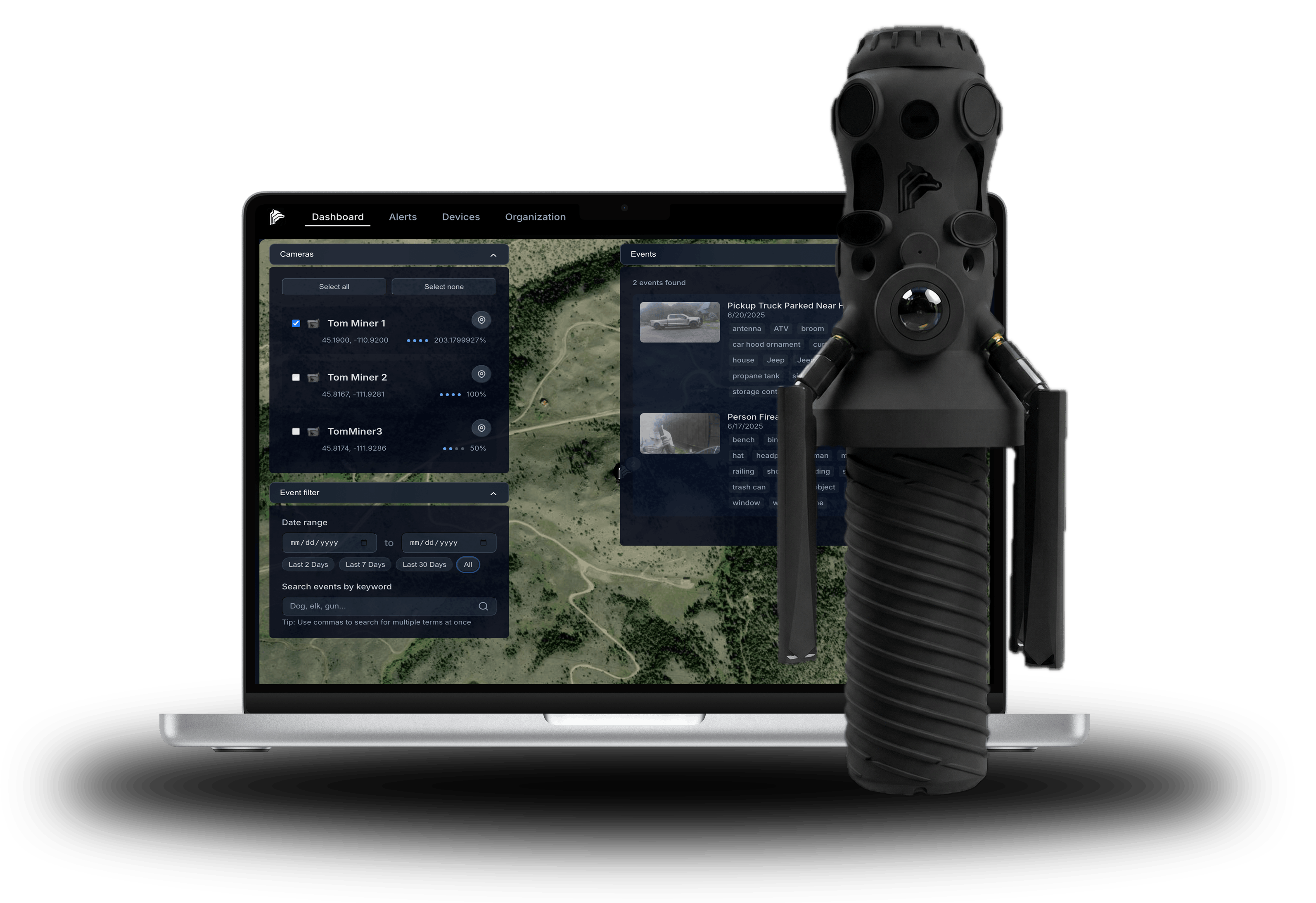
This is the first classifier trained on that dataset — built in GrizCam Desktop, and free to run inside it. GrizCam Desktop turns a biologist's own annotations into a working detector: point it at a labeled set of recordings and it fine-tunes a bioacoustic foundation model — AVES2, Perch 2.0 — onto your target sound, with honest hold-out metrics and no code. The same classifier can be pushed to a GrizCam device to run on the edge, flagging the call in the field the moment it happens.
Counting wolves.
Wolf populations are notoriously hard to count. Wildlife managers set hunting quotas and recovery targets on numbers estimated from tracks, sightings, and a handful of collared animals spread across country too vast to survey directly — and those estimates carry real consequences for the animals and the people who live alongside them. A classifier that turns inexpensive passive recordings into reliable occupancy and abundance signals gives managers a cheaper, wider, and less invasive way to know how many wolves are on the landscape — and to base policy on evidence rather than approximation.
From howls to a detector.
GrizCam Desktop builds species-specific acoustic detectors by transfer learning on frozen foundation-model embeddings. A large audio encoder — pre-trained on millions of sounds (e.g., Earth Species Project’s AVES2 or Google DeepMind’s Perch 2.0) — converts each short audio window into a fixed-length embedding that captures its acoustic content. Rather than fine-tune that encoder (which would demand enormous labeled data), the app freezes it and trains a lightweight multinomial linear probe on top, using only the researcher’s own annotations. A purpose-built detector is therefore trainable from a modest number of examples on a single workstation.
The recipe that produced the results below is applied identically regardless of the target call. Positives are the annotated target (solo howl or chorus). Negatives are multi-class: each labeled confuser (coyote, insect, aircraft, wind, …) becomes its own class, joined by a heterogeneous ambient pool and in-situ background windows mined from the researcher’s own complete recordings — so the detector learns the specific acoustic backdrop of the deployment. One round of hard-negative mining then targets the model’s own worst false alarms. Training augments with time-shift and reverberation, calibrates scores with Platt scaling, and selects a decision threshold from a by-file, 5-fold out-of-fold (OOF) F1 sweep — grouped by source recording so no clip leaks between train and test. Every accuracy number reported here is that leakage-free held-out OOF F1.
To compare foundation models fairly, we ran this exact pipeline four times, swapping only the encoder, on the Cry Wolf Project’s Greater-Yellowstone dataset — isolating the encoder’s contribution from everything else. The same annotate-then-train workflow can also produce a compact, low-power detector — a small end-to-end convolutional network exported to ONNX — that runs on-device on GrizCam edge hardware (ESP32-S3-class) for real-time detection in the field. One labeled dataset can thus serve both a high-accuracy desktop detector and a battery-powered acoustic sentinel deployed on the landscape.
The dataset
The Cry Wolf annotation effort is ongoing (~¼ complete). Projected at completion (current ×4; to be replaced with final counts):
| Target | In hand now | Projected |
|---|---|---|
| Solo howl | 4,891 events · 13.85 hrs | ~19,600 events · ~55 hrs |
| Main chorus | 1,059 events · 14.49 hrs | ~4,240 events · ~58 hrs |
| Total | 5,950 events · 28.33 hrs | ~23,800 events · ~113 hrs |
All manually reviewed, Greater-Yellowstone-Ecosystem wolves, 2023–2025, across ~50+ ARUs spanning ~500 mi² (~1,295 km²). Solo howls run a few seconds; choruses average ~60 s.
Why this dataset matters
The detectors build on large audio foundation models — trained on thousands of hours of audio, but spread across thousands of mostly-bird species, so any single species gets only minutes:
- Microsoft BEATs → AudioSet (~5,700 hrs of general audio: music, speech, machines), wolves a tiny minority.
- Earth Species Project AVES2 → a bioacoustic stage of ~12,000 hrs dominated by birds (~10,400 hrs Xeno-Canto), plus marine mammals (27 hrs) and mixed archives — canids a sliver.
- Google DeepMind Perch 2.0 → ~1.5M recordings across ~14,795 species (bird-dominated); the wolf is one of them.
Divide any of these corpora by their species count and the wolf’s share is on the order of minutes. Our ~113 projected hours of manually-reviewed GYE solo howls and choruses is therefore, to our knowledge, the largest curated wolf-vocalization dataset assembled to pair with these foundation models — and it is behavior- and habitat-specific (solo howl vs. chorus, GYE conditions) in a way no general corpus is. That is the gap GrizCam Desktop closes: the foundation model supplies broad audio understanding; the researcher’s annotations supply the wolf-specific signal it never had.
Accuracy — which foundation model detects wolves best (linear-probe)
Held-out OOF F1 (by-file 5-fold, Platt-calibrated), identical pipeline, encoder varied:
| Foundation model | Type | Howl OOF F1 | Chorus OOF F1 |
|---|---|---|---|
| AVES2 EfficientNet-B0 | CNN | 0.864 | 0.962 |
| AVES2 SL-BEATs | Transformer | 0.903 | 0.979 |
| AVES2 NatureLM-BEATs | Transformer | 0.903 | 0.981 |
| Perch 2.0 | CNN (5 s) | 0.887 | 0.954 |
Performance — how long each detector takes to build and run
Measured on a consumer NVIDIA RTX 5080 (16 GB); identical training recipe, only the encoder changed.
| Foundation model | Type | Time to TRAIN | Inference cost | Howl accuracy |
|---|---|---|---|---|
| AVES2 EfficientNet-B0 | CNN (small, ~5M) | ~22–25 min (fastest) | fastest | 0.864 |
| AVES2 SL-BEATs | Transformer (~90M) | ~30–37 min | ~2× EffNet | 0.903 |
| AVES2 NatureLM-BEATs | Transformer (~90M) | ~30–40 min | ~2× EffNet | 0.903 |
| Perch 2.0 | CNN, EfficientNet-B3 (~12M), 5 s window | ~93 min howl / ~125 min chorus | ~4× EffNet | 0.887 |
Why the differences: model type/size (small CNN vs 90M transformer); Perch’s 5 s window spans ~2× the windows; and hardware fit (Perch uses ~6 GB GPU).
In fairness to Perch 2.0: that ~2× window count is a deliberate choice, not a limitation — we ran Perch across a ~10 s span to capture the full temporal structure of howls and choruses, which unfold over seconds to a minute. Constrained to shorter windows, Perch would run considerably faster; we traded that speed for the longer-context view.
The accuracy tradeoff (honest): the fastest encoder (EfficientNet-B0) is also the least accurate for howls (0.864); the most accurate (the BEATs transformers) win both targets at ~1.5× the time; Perch is close on accuracy, but its real strength is breadth — trained on ~1.5M recordings across ~14,795 species, it’s built into GrizCam Desktop as a one-off classifier for quickly identifying any sound, with the ability to filter classification by geographical region. Practical guidance: EfficientNet for speed/modest hardware; a BEATs encoder for best accuracy; Perch for cross-species/mixed-taxa work.
Beyond the benchmark — early out-of-domain results
The numbers above are held-out within the training region. In separate testing against out-of-domain recordings, the detectors show encouraging results on the two things that matter most to a wildlife manager: reliably catching real wolf vocalizations (few missed calls), and — just as important — not false-alarming on the look-alike confounders that dominate real-world audio: coyotes, insects, aircraft, and road noise. Keeping those from triggering a detector is the entire point of a tool called Cry Wolf. A more formal out-of-domain evaluation is forthcoming.
The fine print
These are single-region held-out (OOF) results under a linear probe. A linear probe is known to under-represent transformer encoders, so the two BEATs models’ advantage may be understated. A full matched-probe, cross-site sweep (attention-probe head + leave-one-site-out test) is coming in the next few months and may refine the ranking.
What’s coming (planned contributions)
- An on-device deterrent loop — real-time wolf detection on a GrizCam edge device that, on a nearby howl, triggers Halter virtual-fence collars on the cattle to flash and deter the approaching wolves, a scientifically validated non-lethal deterrent — closing the loop from passive detection to automated, predator-friendly livestock protection.
- Continue improving inference performance. With our most-accurate wolf classifier on the test rig below, one hour of audio classifies in about 5.8 seconds on the CUDA (GPU) Windows build (~620× real time) or about 95 seconds CPU-only (~38× real time). A 1,000-hour field season processes in roughly 1.6 hours on GPU or about a day on CPU. Test rig: Intel Core Ultra 9 285K (24-core) CPU, NVIDIA RTX 5080 (16 GB) GPU, 96 GB RAM, NVMe SSD. Wildlife managers have a lot of data; they don’t have time to lose.
- The full matched-probe encoder sweep (attention-probe head + cross-site test).
- A wolf individual-ID + “contour” ablation — using a Cry Wolf Project subset tied to known individual wolves, testing whether identity (and the transformer’s edge) lives in the time-varying pitch contour of a howl vs its static average — a clean test the wolf literature has not run, on wild recordings.
Acknowledgments
With thanks to Tom Denton (Google), Cody Goldhahn, Cameron Ho, Claire Lacey, Matt Metz, Marius Miron (Earth Species Project), Taylor Rabe, Gordon Scott, Dan Stahler (National Park Service), Jeremy Sunderaj, Amir Dehbi, Koy Holland, Wild Livelihoods, Colossal Biosciences, Cultivo, and Yellowstone Forever.
Can AI help us
speak with wolves?
Co-founder Dr. Jeff Reed on what the wild has been saying all along — and what off-grid sensing finally lets us hear.